Mechanism of Psychological Counseling on Group Cooperative Behavior among University Students from the Perspective of Emotional Migration
Abstract
Abstract
Background and Gaps: The quality of cooperative behavior among university students directly affects the achievement of higher education talent cultivation objectives. However, existing psychological counseling research primarily focuses on individual emotion regulation and mental health improvement, leaving a significant gap in systematically exploring how such interventions indirectly influence class-level cooperative behavior through emotional transmission mechanisms. In particular, emotional transfer, as a core mediating mechanism linking individual psychological states with group social choices, lacks a cross-disciplinary quantitative analytical framework in educational contexts.
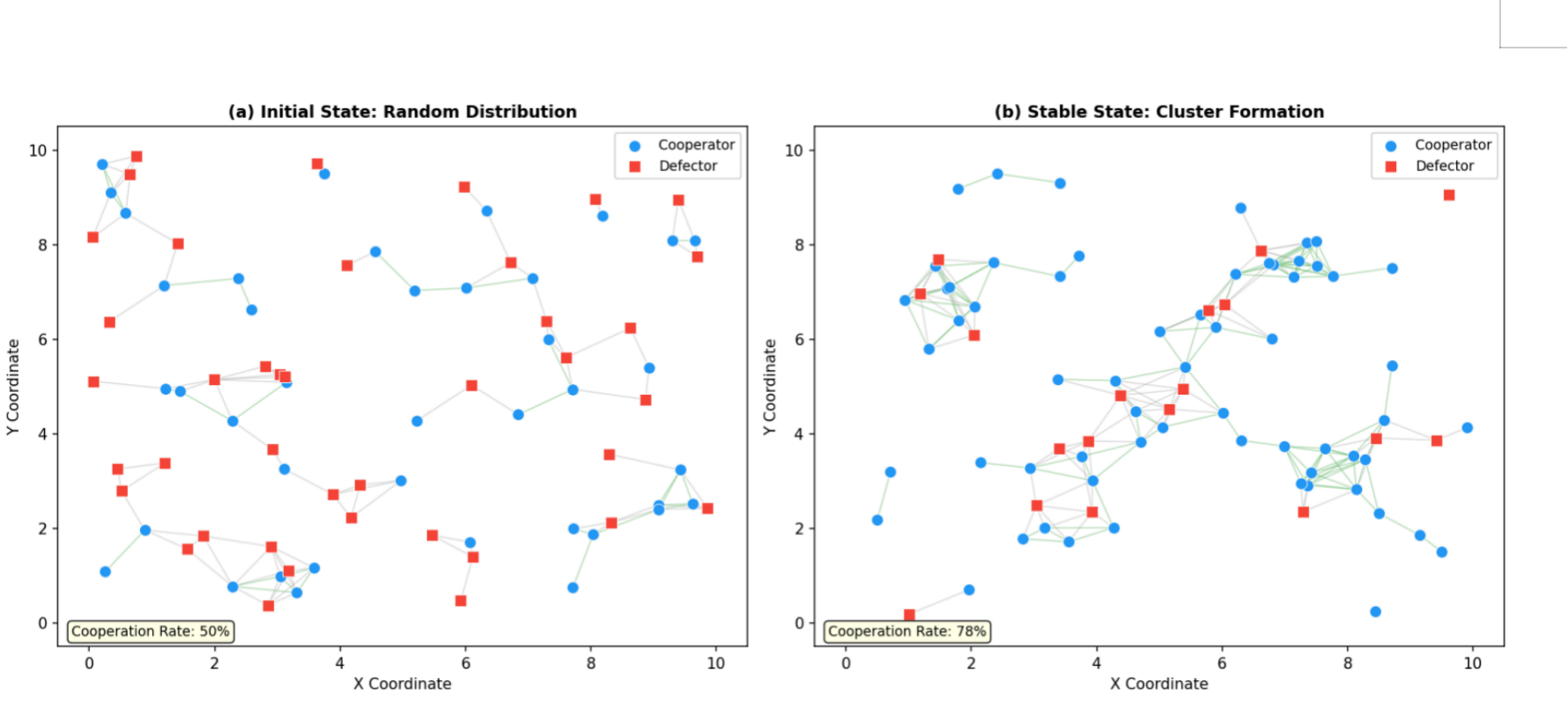
Methods: This study integrates public goods game theory, complex network dynamics, and educational psychology to construct a quantitative model of emotional transfer applicable to university classroom social scenarios. Emotional attitude indices (acceptance, rejection, and emotional value) serve as core variables, while transfer intensity (v) and interaction radius (R) function as regulatory parameters. The model systematically characterizes how psychological counseling interventions influence group cooperation levels through emotional transfer pathways.
Practical Approach: A mixed-method research design combining complex network simulations and empirical investigation was employed. A sample of 120 university students participated, with dual-track validation of the theoretical model conducted via questionnaire surveys (SPSS/AMOS mediation effect tests) and Monte Carlo simulations (10,000-step iterations, 20 independent repetitions).
Key Findings: Emotional transfer exhibits a significant "double-edged sword effect" in the relationship between psychological counseling and group cooperation. When counseling frequency is moderate (2–3 times per month), transfer intensity is within the optimal range (0.10 ≤ v ≤ 0.30), and interaction radius is stable (0.30 ≤ R ≤ 0.50), positive emotional transfer significantly promotes virtuous interpersonal cycles, with group cooperation rates rising above 0.82. Conversely, excessive counseling or frequent emotional fluctuations causing transfer intensity to exceed critical thresholds (v > 0.35) or over-expansion of interaction radius (R > 0.55) leads to irrational emotional transfer, undermining group trust and causing cooperation rates to drop below 0.30, potentially resulting in group disintegration.
Significance: Theoretically, this study enriches cross-disciplinary research on the emotional transfer mechanism in educational settings. Practically, it provides actionable quantitative evidence for the precise design of university psychological counseling systems and the scientific formulation of class-level cooperative governance strategies.
Keywords: emotional transfer; psychological counseling; group cooperation; public goods game; complex networks; university students