Editorial Process
Creative Engineering is committed to upholding high standards of academic quality through a rigorous and transparent double-blind peer review process, jointly managed by researchers and academic editors throughout. To ensure review efficiency, authors are advised to carefully review and adhere to the editorial office's pre-submission checklist before submitting their work, thereby avoiding rejection due to formatting or content non-compliance. All submissions are processed according to the following workflow: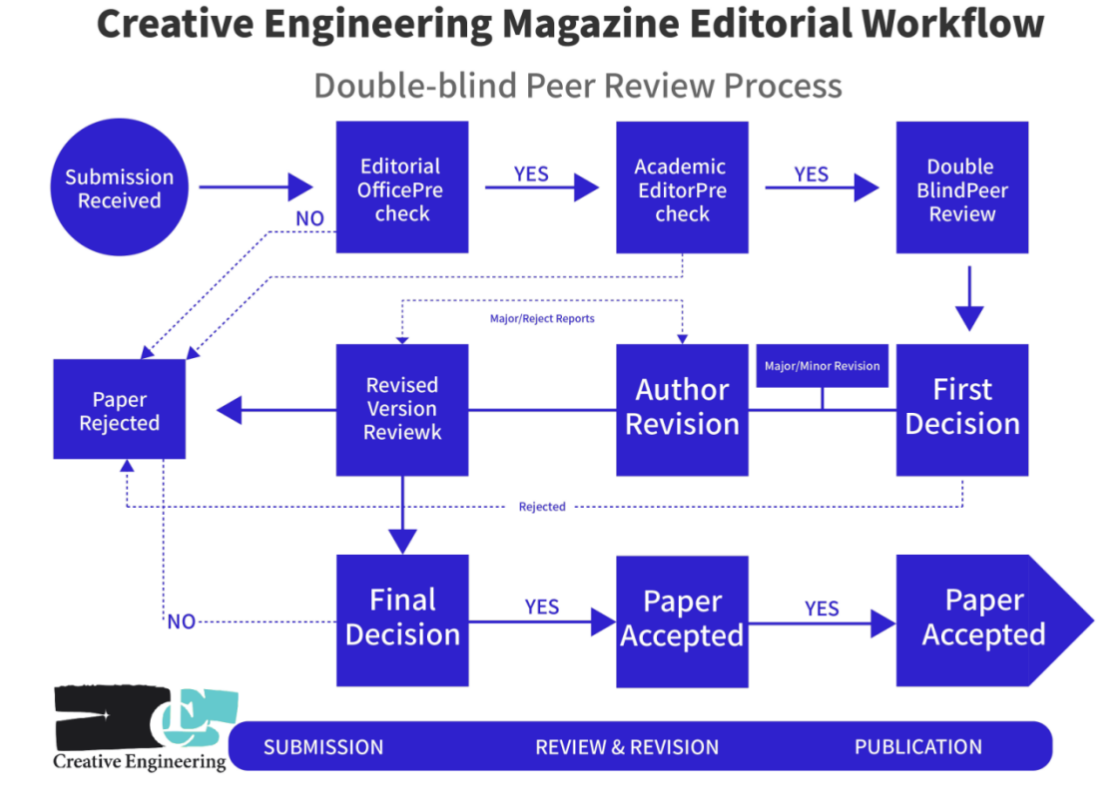
Overview of the Peer Review Process
All submitted manuscripts undergo a double-blind peer review process involving three independent reviewers. The final decision to accept or reject a manuscript is made by the Editor-in-Chief or an authorized academic editor.
Pre-Review Stage
The pre-review stage comprises two primary steps: a technical pre-check conducted by the editorial office and an editorial pre-review performed by an academic editor.
Technical Pre-screening (Conducted by Editorial Office)
Upon submission, the journal's managing editor performs a technical pre-screening, primarily evaluating the following aspects:
·Whether the manuscript is generally suitable for the journal and its relevant columns, special issues, or themes;
·Compliance with high-quality research and publication ethics standards;
·Whether the research rigor meets the basic requirements for external review;
·Whether the paper format conforms to journal specifications.
Editorial Pre-screening (Conducted by Academic Editors)
The academic editor (including the Editor-in-Chief for regular submissions, guest editors for special issues, topic editors, anthology editors, or editorial board members designated by the Editor-in-Chief in cases of conflict of interest) will evaluate:
·Whether the manuscript falls within the journal's disciplinary scope;
·Whether the research possesses fundamental academic or engineering value;
·Whether there are obvious ethical risks (e.g., data anomalies, author disputes, etc.);
·Whether the manuscript meets the basic threshold for academic quality.
Based on the above assessment, the academic editor may choose to reject the manuscript, request revisions before submission for review, or directly recommend reviewers for the external peer review process.
(3) Conflict of Interest Management
To avoid conflicts of interest, guest editors, special issue editors, and portfolio editors shall not handle submissions to special issues, themes, or portfolios under their responsibility. Such submissions will be processed by other editorial board members. Additionally, the Editor-in-Chief and other editorial board members listed as authors of a manuscript shall not participate in or influence the review process for that manuscript.
Peer Review Process
Review Method: This journal employs a double-blind peer review system, where neither reviewers nor authors know each other's identities.
Number of Reviewers: Each manuscript must receive at least three independent review opinions.
Reviewer Selection.
·```Academic editors may recommend reviewers during the pre-screening phase;
·The editorial office may select reviewers from the editorial board, reviewer database, or literature searches;
·Authors may suggest reviewers or request recusal. The editorial office will respect such suggestions while ensuring review objectivity and will conduct conflict-of-interest reviews for all recommendations.
Reviewer Qualifications:
·Hold a doctoral degree or equivalent research credentials;
·No conflict of interest with the authors and not affiliated with the same institution;
·Possess expertise in the relevant field and extensive publication experience, with no co-authored publications with the authors within the past three years.
Reviewer Responsibilities:
·Possess sufficient expertise to evaluate manuscripts, provide high-quality review comments, and maintain responsiveness throughout the process;
·Evaluate based on evidence and professional judgment, offering specific, constructive, and academically respectful revision suggestions;
·Maintain confidentiality regarding manuscript content and promptly report suspected academic misconduct.
Review Criteria:Reviewers primarily evaluate manuscripts based on:
·Originality and technical reliability;
·Adequacy of methods and experimental validation;
·Reasonableness of conclusions;
·Engineering relevance or applied value.
Review Cycle:
·Typical review cycle: 7–10 days; resubmission review cycle: approximately 3 days;
·Extensions may be requested if needed.
Author Revision Stage
Authors receiving “minor revisions” or “major revisions” must resubmit the revised manuscript.
If reviewer comments conflict or include rejection recommendations, the editorial office will consult the academic editor before feedback and may decide to add reviewers or conduct further review.
Resubmission Review: Manuscripts requiring major revisions or involving rejection recommendations are typically returned to the original reviewers for re-evaluation.
Revision Rounds:
Manuscripts generally undergo 1–2 rounds of revision;
Minor revisions may be handled directly by the editor; major revisions typically require at least one additional external review;
If core issues remain unresolved after multiple rounds, the manuscript may be rejected to ensure review efficiency and publication quality.
Revision Timeline:
If anticipated revisions exceed 2 months, authors are advised to withdraw and resubmit to ensure sufficient revision time.
Editorial Decision
Upon receiving three review opinions, the academic editor (Editor-in-Chief, Guest Editor, Special Issue Editor, or Editorial Board member) makes the final decision. Editors may not participate in any processing of manuscripts they are affiliated with.
Decision Criteria: Editors comprehensively evaluate the following aspects:
·Rationality of reviewer selection;
·Adequacy of review comments and author responses;
·Overall scientific and technical quality of the manuscript.
Decision Types: Include acceptance without revision, acceptance with minor revisions, rejection without recommendation for resubmission, rejection but welcome to resubmit, request for further revision, or request for additional review.
Opinion Resolution: If the academic editor favors acceptance but reviewers recommend rejection, the editorial office will seek a second opinion from other editorial board members or the Editor-in-Chief.
Result Notification: Acceptance decisions are made solely by the academic editor, while the editorial office communicates the outcome to authors.
Special Issues
All submissions to special issues undergo the same rigorous and impartial peer review process as regular submissions. Guest editors oversee the editorial review process for special issue manuscripts and provide comprehensive review recommendations based on all reviewers' feedback. Manuscripts submitted by guest editors themselves to the special issue they oversee must undergo an independent review process, and the number of their accepted manuscripts shall not exceed 25% of the total articles published in that special issue.
Author Appeal Mechanism
Authors may appeal decisions of “Rejected without recommendation for resubmission.” Appeals must be submitted via email to the editorial office within three months of receiving the decision notification, accompanied by detailed grounds for appeal, including point-by-point responses to reviewer comments and editorial decisions. Appeals failing to meet these requirements will not be considered.
Upon receiving an appeal, the Executive Editor will forward the manuscript and relevant review materials to a designated member of the Editorial Board for reconsideration. The invited Academic Editor may recommend acceptance, request further review, or uphold the original rejection. The final decision rests with the Editor-in-Chief. Decisions made at this stage are final and no secondary appeals will be accepted.
Publication Preparation and Production
All accepted manuscripts will undergo subsequent publication processing by BIG.D's internal production team, including language editing and manuscript editing. Language editing is performed by professional English editors. Should a manuscript require substantial linguistic revisions or formatting adjustments, the journal may offer paid English editing services upon prior author consent. Authors may also independently select third-party editing services.
Publication Ethics
This journal strictly adheres to the processes and best practices established by the Committee on Publication Ethics (COPE) to address potential misconduct involving authors, reviewers, or editors. All editors have received training to identify and appropriately handle ethical issues. For further details, please refer to the COPE Guidelines on Peer Review Ethics.
Editorial Independence Statement
All articles published in this journal undergo academic review by an independent editorial board. Internal staff members do not participate in decisions regarding manuscript acceptance or rejection. Academic editors base their decisions solely on the following objective academic criteria:
·Professional alignment and academic qualifications of selected reviewers;
·Substantive content and adequacy of review comments and author responses;
·Overall scientific quality and integrity of the manuscript.
Guidelines for Using Artificial Intelligence Technology
Author Guidelines: Authors may use AI-assisted tools for text or image editing provided no plagiarized or fabricated content is introduced. All AI tool usage must be disclosed in the cover letter and appropriate sections of the manuscript. AI tools such as chatbots shall not be listed as authors.
Reviewer Guidelines: Reviewers using AI tools to assist in peer review must disclose such use to the journal. Reviewers remain fully responsible for the content and academic judgments of their submitted review comments.
Confidentiality and Right to Reject
During peer review, submitted manuscripts are handled or accessed only by the responsible editor, academic editor, reviewers, and production editor to the extent necessary. At any stage prior to publication, including after acceptance, the editorial board reserves the right to reject a manuscript if reasonable doubts arise regarding its academic integrity.