Impact of Indoor Thermal–Humidity and Lighting Environments on Cognitive Performance and Work Efficiency of Knowledge Workers in Open-Plan Offices: An Empirical Study Based on a Multifactorial Cross-Experimental Design
Abstract
Abstract
Background and Research Gap: With the rapid development of the knowledge economy, open-plan office spaces have become a dominant design trend due to their ability to facilitate communication and improve spatial efficiency. However, the potential negative effects of complex indoor physical environments—particularly thermal–humidity and lighting conditions—on the cognitive performance of knowledge workers have become increasingly evident. Existing studies predominantly focus on the isolated effects of single environmental factors on specific physiological indicators, lacking systematic experimental investigations into the interaction mechanisms of thermo–visual multisensory environments from an interdisciplinary design perspective.
Methods: This study employed a multifactorial cross-experimental design to systematically examine the interactive effects of different temperature conditions (22°C, 26°C, 30°C) and correlated color temperature (CCT)/illuminance combinations (3000K/300 lx, 4000K/500 lx, 6000K/750 lx) on cognitive performance within a controlled simulated open-plan office environment.
Experimental Protocol: A total of 90 healthy knowledge workers were recruited. Neurophysiological responses were continuously monitored using electroencephalography (EEG). Data were collected through a multimodal approach integrating standardized cognitive tasks—including the N-back working memory test and the Stroop executive control test—with subjective questionnaires.
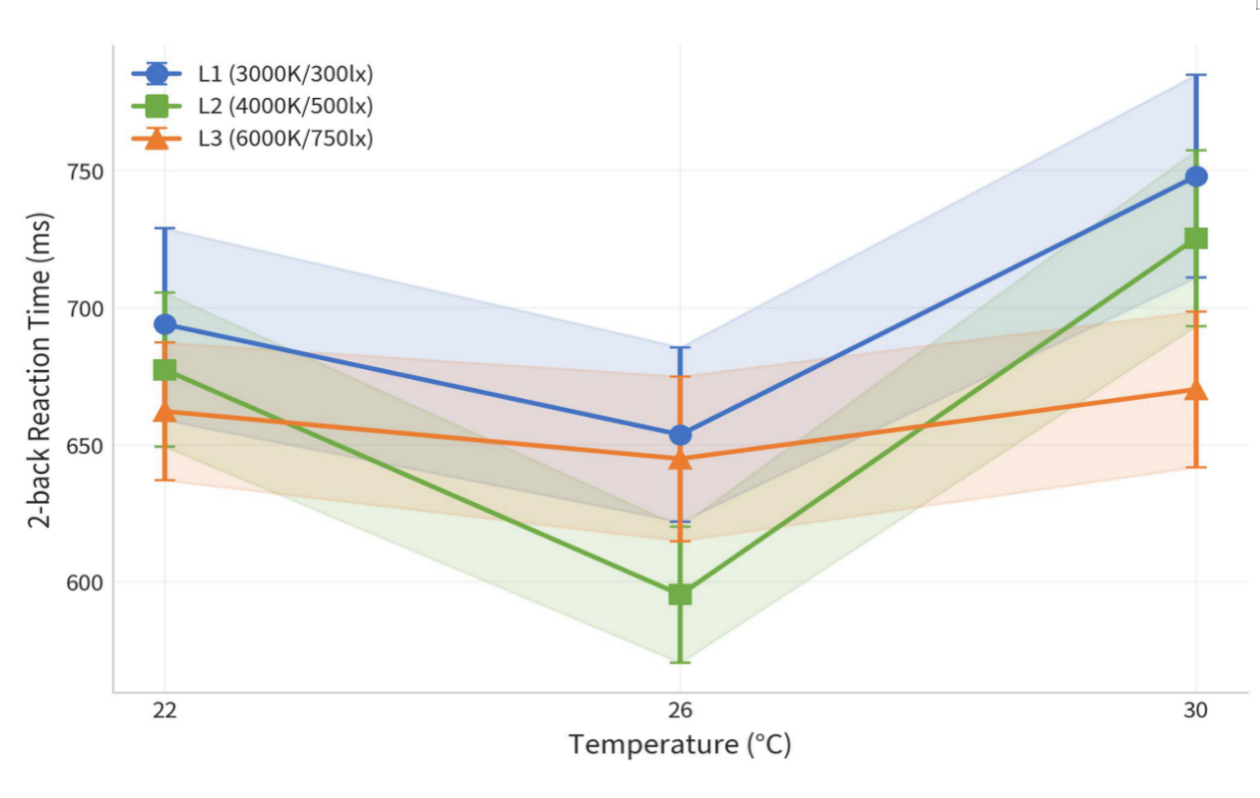
Key Findings: The results reveal a significant nonlinear interaction effect between thermal–humidity and lighting environments in modulating cognitive performance. Under warm conditions (30°C), high CCT and high illuminance (6000K/750 lx) cool-white lighting significantly mitigated thermal stress–induced cognitive load, improving working memory accuracy by 12.4%. Under neutral thermal conditions (26°C), moderate CCT and illuminance (4000K/500 lx) yielded optimal cognitive efficiency and enhanced activation in the EEG Alpha band.
Significance: This study elucidates the synergistic regulatory mechanisms of multiple indoor physical environmental factors on higher-order cognitive functions. It provides a robust theoretical foundation for the design of adaptive environmental control systems in future intelligent office spaces, highlighting the substantial potential of integrating design disciplines with human factors engineering to enhance workplace health and productivity.
Keywords: Open-plan office; Thermal–humidity environment; Lighting environment; Cognitive performance; Electroencephalography (EEG); Cross-design