Conveying Urban Noise Health Data through Interactive Soundscape Art Installations: The Role of Emotional Resonance and Memory Consolidation in Promoting Noise-Reduction Behaviors
Keywords:
Soundscape art installation; Urban noise pollution; Emotional response; Memory consolidation; Behavior change; Design innovationAbstract
Abstract
Background and Gaps: Urban noise pollution has emerged as a significant global public health issue. However, conventional scientific data communication methods are often ineffective in altering public noise-reduction behaviors. Existing research indicates that mere information delivery frequently fails to overcome cognitive biases and behavioral inertia related to environmental risks.
Methods: This study employed a case-control design and conducted a 2.5-year longitudinal investigation across four urban communities. A total of 90 participants were recruited and randomly assigned to either the soundscape art installation group (n=46) or a manual-based control group (n=44). The soundscape art installations transformed complex urban noise data into a multisensory immersive experience, integrating visual, auditory, and tactile stimuli.
Intervention Approach: Qualitative methods, including focus group discussions, semi-structured interviews, and text-based sentiment analysis, were combined with quantitative measures such as behavioral intention scales, memory recall tests, and direct behavioral observations. Focus group discussions were conducted immediately post-intervention (n=26), and follow-up assessments were performed at six months (n=70).
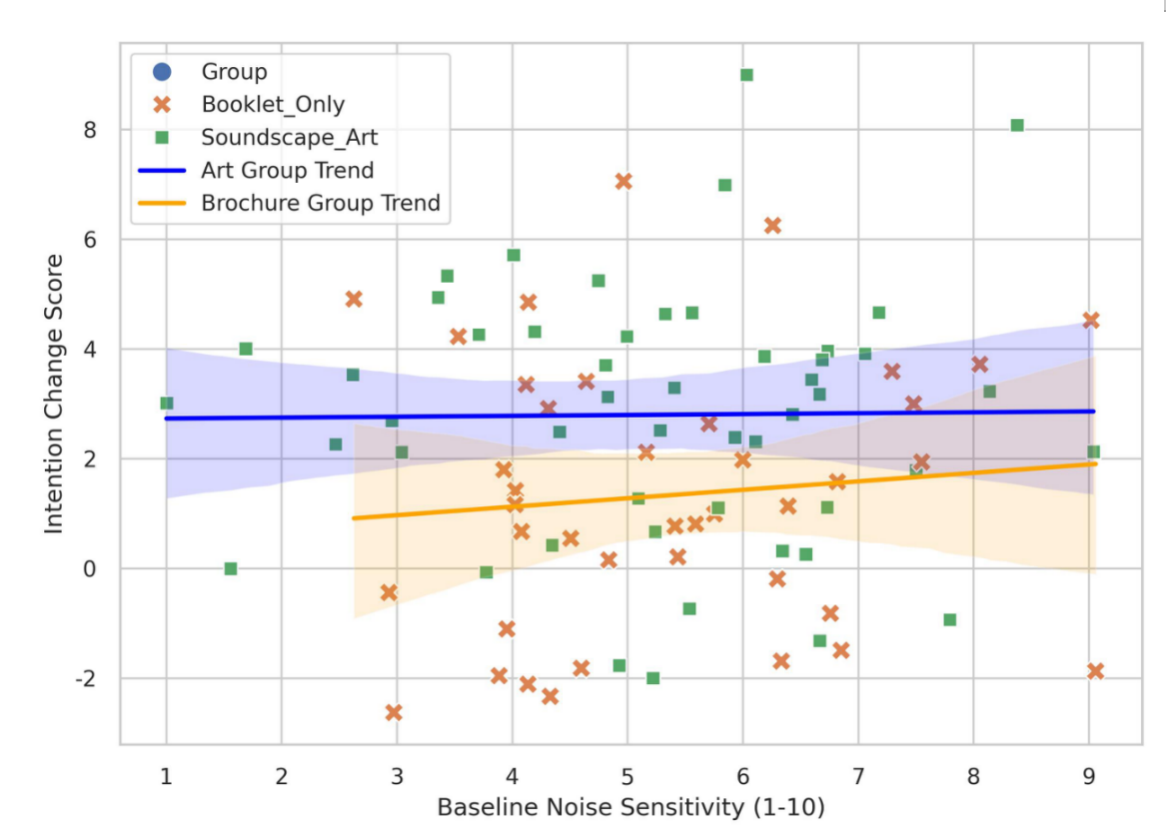
Key Findings: Participants in the soundscape art installation group exhibited significantly stronger emotional responses than those in the control group (M=7.2 vs. 5.1, t(88)=8.42, p<0.0001, d=1.85). Post-intervention, the installation group demonstrated a greater change in behavioral intentions (M=1.8 vs. 0.6, t(88)=7.15, p<0.0001, d=1.52). Six-month follow-up results indicated higher accuracy in noise-level recall among installation participants (M=0.74 vs. 0.62, t(68)=3.68, p=0.0008, d=0.68) and more pronounced actual noise-reduction behavior changes (M=3.1 vs. 1.9, t(68)=4.52, p=0.0002, d=0.95).
Significance: This study systematically demonstrates, for the first time, the effectiveness of artistic data communication in overcoming barriers inherent to traditional scientific communication, particularly by eliciting emotional resonance and enhancing memory consolidation to promote pro-environmental behavior change. The findings provide a novel theoretical framework for design innovation, suggesting that integrating complex environmental data with artistic expression can significantly increase public engagement in environmental actions. These results offer empirical evidence for urban noise control policies, public health communication, and community participation initiatives.
Keywords: Soundscape art installation; Urban noise pollution; Emotional response; Memory consolidation; Behavior change; Design innovation