Constructing Multidimensional User Personas for Community-Based Chronic Disease Patients Based on Digital Literacy, Health Status, and Social Support: A Cross-Disciplinary Study for Digital Health Product Design
Keywords:
User Persona; Digital Health Products; Chronic Disease Management; Two-step Clustering; Inclusive DesignAbstract
Abstract
Research Background and Gaps: With the global population aging and the prevalence of chronic diseases continuously rising, digital health products—such as wearable devices and chronic disease management applications—play an increasingly important role in the self-management of community-dwelling patients with chronic conditions. However, existing digital health product designs often adopt a “one-size-fits-all” approach, overlooking significant differences among patients in digital literacy, health status, and social support. Such technology-centered rather than capability-centered designs result in low adoption rates, poor user retention, and insufficient alignment with the real needs of patients across varying ability levels.
Research Methods: This study proposes a methodology for constructing user personas of patients with chronic diseases, suitable for large samples and multivariate analysis. By integrating three dimensions—digital literacy, health status, and social support—and employing a hybrid clustering strategy that alternates between manual screening and two-step clustering, the approach systematically segments large-sample data.
Practical Implementation: The study is based on health management tracking survey data of community-dwelling patients with chronic diseases in a certain city. A total of 3,856 residents aged 50–85 with one or more chronic conditions were selected as valid samples. Twenty-eight subdomain variables were extracted, encompassing demographic characteristics, comorbidity profiles, device operation skills, information acquisition capabilities, and family caregiving status. Using computer-assisted tools (SPSS and Python) to optimize the data analysis workflow, a multidimensional user persona framework was constructed.
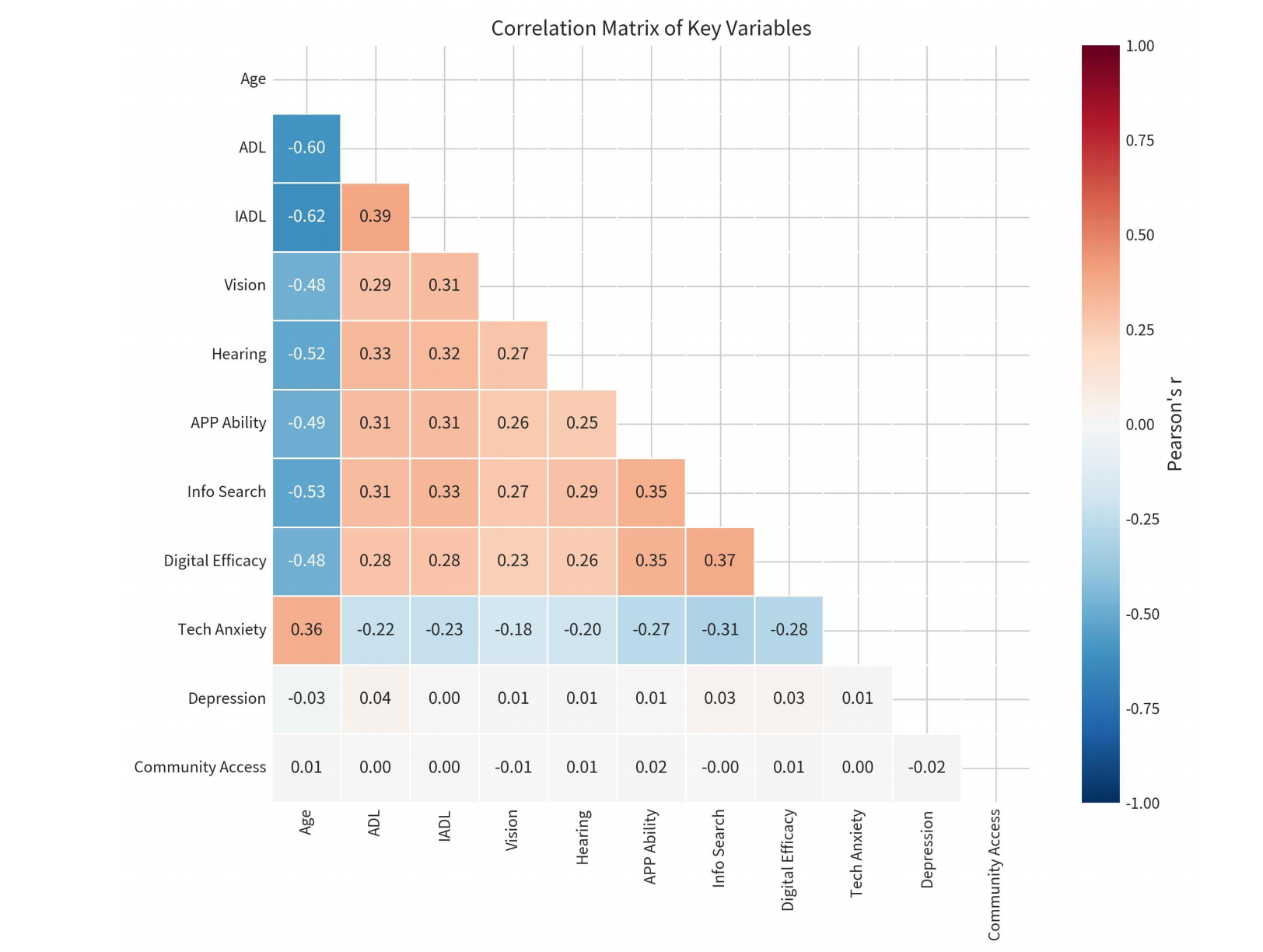
Core Findings: The study ultimately identified 26 distinct user persona clusters among community patients with chronic diseases. Each cluster was defined comprehensively by digital literacy level, degree of health impairment, psychological traits, and social network background. The findings indicate a nonlinear negative correlation between age and digital literacy, while social support systems play a key moderating role in compensating for low digital literacy among elderly patients.
Significance and Contribution: The multidimensional user persona framework developed in this study provides a clear and practical pathway for inclusive design of digital health products. It not only offers a generalizable methodological reference for user research in interdisciplinary design and innovation but also provides scientific guidance for functional planning, interaction adaptation, and sample selection in digital medical devices and chronic disease management platforms. Ultimately, it facilitates the design of age-friendly and barrier-free solutions that precisely match the capabilities of target users.
Keywords: User Persona; Digital Health Products; Chronic Disease Management; Two-step Clustering; Inclusive Design